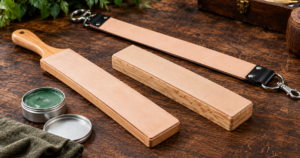
A sharp, polished knife edge requires more than occasional sharpening. Proper stropping helps refine the cutting edge, remove fine burrs, and maintain cutting performance between sharpening sessions.
While a plain leather strop can be effective, using the right leather stropping compound can provide additional abrasive action for edge refinement and polishing.
In this guide, we’ll explain how stropping compounds work, how to use them correctly, and how to maintain your sharpening strop.
What Is a Stropping Compound?
A stropping compound is a fine abrasive material applied to a compatible stropping surface to help polish and refine a cutting edge.
Unlike sharpening stones, which are commonly used to establish or restore an edge, strops with fine abrasive compounds are generally used during the finishing stages of blade maintenance.
Stropping compounds are available in different abrasive materials, particle sizes, and formulations.
Common options include:
- Green compounds: Often contain chromium oxide and are commonly used for fine edge polishing.
- White compounds: Vary in formulation and may be used for polishing or finishing.
- Diamond compounds: Available in different micron sizes for controlled abrasive refinement.
- Plain leather: Can be used without compound for routine stropping and edge maintenance.
Compound color alone does not reliably indicate grit or abrasive performance. Always check the manufacturer’s specifications.
How to Apply Stropping Compound to Leather
Applying the correct amount of compound helps create a consistent stropping surface.
Step 1 — Clean the Strop
Make sure the leather is clean, dry, and free from dust or unwanted abrasive particles.
Step 2 — Apply a Thin Layer
Apply a small amount of compatible compound evenly across the working surface. Avoid excessive buildup.
Step 3 — Position the Blade
Place the blade at an angle appropriate to its existing cutting edge.
Step 4 — Use Edge-Trailing Strokes
Move the blade across the leather with the cutting edge trailing. Maintain light pressure and a consistent angle.
Step 5 — Alternate and Inspect
Repeat the process on both sides of the blade and inspect the edge after several controlled passes.
Remember that excessive pressure or an incorrect stropping angle can round the cutting edge.
Which Strops Work Best with Polishing Compounds?
Different stropping tools offer different advantages when used with compatible abrasive compounds.
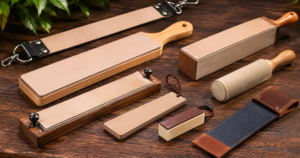
Paddle Strops
Paddle strops provide a firm leather surface mounted on a wooden base. Their stable design makes them convenient for routine knife maintenance and controlled edge polishing.
Four-Sided Quad Strops
Four-sided quad strops offer multiple working surfaces, making them useful for separating different compatible compounds or polishing stages.
For example, users may dedicate one surface to a coarser finishing compound and another to a finer abrasive.
Balsa Wood Strops
Balsa wood strops provide a firm, relatively flat surface that can be used with suitable diamond sprays or other compatible abrasive compounds.
They are popular for controlled finishing applications where users prefer a less compressible stropping surface.
Tabletop Strops
Tabletop strops offer a stable sharpening-station setup for regular knife maintenance, woodworking tools, and compatible precision blades.
Always confirm that the chosen compound is suitable for the strop’s specific surface material.
How to Maintain Your Leather Sharpening Strop
Proper care helps keep a leather strop ready for consistent use.
- Keep it dry: Avoid excessive moisture and prolonged exposure to direct sunlight.
- Prevent contamination: Keep coarse abrasives, metal particles, and dirt away from clean finishing surfaces.
- Avoid excessive compound: Apply only the amount needed for effective stropping.
- Store it carefully: Protect the working surface from scratches, folds, and accidental damage.
- Use appropriate cleaners: Avoid harsh chemicals and unapproved leather treatments.
If you use multiple compounds, consider keeping separate strops or dedicated stropping surfaces to prevent cross-contamination.
Can Stropping Replace Knife Sharpening?
Stropping and sharpening serve different purposes.
Stropping helps refine and maintain an existing cutting edge, while sharpening is generally necessary when a blade becomes significantly dull, chipped, or damaged.
A properly maintained strop can complement your sharpening routine, but it cannot replace every stage of edge restoration.
Final Thoughts
Understanding how to use stropping compounds can help you achieve more consistent blade finishing results.
Whether you prefer plain leather, fine polishing compounds, or multi-stage edge refinement, choosing a suitable stropping surface is essential.
At Super Edge Strops, we offer a wide selection of leather sharpening strops, paddle strops, four-sided quad strops, balsa wood strops, and other blade maintenance accessories.
Explore Super Edge Strops and discover the right tools for precision blade care.